Soaring High: Drones and AI Brighten Solar Farm Inspections!

===INTRO:===
In a world that’s rapidly shifting towards sustainable energy sources, solar farms are vital players in the green revolution. However, with sprawling sites spanning hundreds of acres, monitoring these energy powerhouses for defects and inefficiencies can be a downright daunting task. Enter drones and artificial intelligence (AI), swooping in to revolutionize solar farm inspections and bring us one step closer to a bright, eco-friendly future.

Sun, Sky, and Silicon: Drones Usher in a New Era for Solar Energy

Up in the sky, where the sun’s rays meet the metallic sheen of hovering drones, a new chapter in solar farm maintenance is being written. These high-tech marvels are becoming an integral part of solar farm inspections, effortlessly gliding over panels to scan for potential problems. Drones can cover vast distances in a fraction of the time it would take a human inspector, turning the tedious task of manually examining each panel into a swift and efficient process.

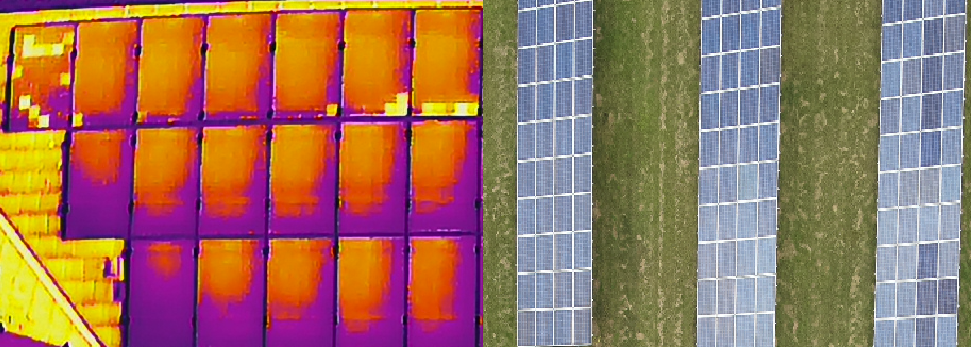
Armed with high-resolution cameras and thermal imaging technology, drones can detect panel defects or soiling that are almost invisible to the human eye. They can swoop in closer for a more detailed inspection, making it easier to pinpoint anomalies such as hotspots, cracks, or malfunctioning cells. What’s more, drones offer the ability to perform these inspections with minimal disruption to the farm’s operations, making them a valuable tool in maintaining the consistent energy output of solar plants.

Re-imagining Solar Inspections: AI, Drones and a Greener Tomorrow!

But the real magic happens when drones team up with artificial intelligence. AI algorithms trained to identify and categorize solar panel defects can analyze the massive volumes of data collected by drones during their flights. This powerful duo can detect problems faster and more accurately than ever before, predicting potential failures before they even occur.

Just think of the possibilities: AI can identify a tiny defect in a sea of gleaming panels, direct a drone to take a closer look, and even suggest a repair strategy. This would greatly speed up the maintenance process, keeping solar farms at peak performance and reducing energy waste. It’s a vision of the future where technology serves the environment in a symphony of efficiency and sustainability.

===OUTRO:===
As we continue to harness the sun’s power to fuel our world, it’s comforting to know that drones and AI are there to help us make the most of it. They are the unseen heroes of the solar energy sector, tirelessly scanning the horizon for ways to make our sustainable energy dreams a reality. It’s a testament to human innovation, a harmonious marriage between technology and nature, giving us hope for a brighter, greener tomorrow. So, as the drones buzz above the solar farms, we can be sure that the future of solar energy is shining brightly, high in the sky!
Sky-High Inspections: UAVs Revolutionize Building Assessments!

===INTRO:===

Gone are the days when building inspectors needed to scale sky-high buildings and structures to make proper assessments. Welcome to the revolutionary future where unmanned aerial vehicles or drones are taking charge, making building inspections not only more efficient but safer and cost-effective too. Let’s embark on a journey into the world of drone-enabled building checks!

Soaring to New Heights: Drones Transform Building Checks!

In the world of building inspections, drones are fast becoming the tool of choice for inspection professionals. With their ability to fly high above the ground and capture detailed images, drones are revolutionizing the way we inspect buildings. Using sophisticated cameras and sensors, they can identify issues such as structural damage, wear and tear, and potential safety hazards. All this without the need for inspectors to risk their lives or spend long hours climbing treacherous scaffolding.

Not only are drones able to cover larger areas in a shorter span of time, but they also offer better visibility compared to traditional inspection methods. High-resolution cameras paired with intelligent software can create 3D models of the building, enabling an in-depth analysis of the property. This technology not only allows for a comprehensive inspection but also offers valuable data for future maintenance and repair planning. The sky is really the limit when it comes to the possibilities drones bring to building assessments!

From Ground to Air: The Uplifting Shift in Property Inspections!

The shift from ground to air in property inspections has truly been an uplifting one. Traditional ground-based inspections required more time, more manpower, and carried more risk. But now, drones are flipping this model on its head and taking the industry by storm.

Property inspections using drones are not only faster and safer but also more accurate. With advanced thermal imaging capabilities, drones can identify hidden faults and issues that are often missed in manual inspections. Moreover, they can easily access hard-to-reach areas such as rooftops, facades, and tall chimneys, which would otherwise be difficult and dangerous for human inspectors.

At a time when the demand for quick and accurate property assessments is more than ever, drones are proving to be a game-changer. By providing a bird’s eye view, they are making property inspection a less daunting and more precise process. It’s no wonder then that more and more inspection firms are making the shift and embracing drone technology!

===OUTRO:===

In conclusion, the dawn of drone technology in property inspections is a welcome change, bringing a new level of efficiency, safety, and accuracy to the process. As this technology continues to evolve and improve, we can expect even more advancements in the way we inspect buildings. The revolution is here, and it’s flying high in the sky! So next time you see a drone buzzing around a building, remember, it’s not just about taking aerial shots; it’s about revolutionizing the way we assess and maintain our buildings. Drone-powered building inspections – a clear view of the future from the sky!

Photoluminescence vs Electroluminescence in Solar Farm Inspections: A Comparative Analysis

In the fast-evolving field of solar farm inspections, understanding the differences between photoluminescence (PL) and electroluminescence (EL) is crucial for optimising solar panel performance and longevity. Both techniques play a significant role in detecting defects and ensuring the efficiency of solar farms, but they serve different purposes and have unique advantages. This article delves into the key differences between photoluminescence and electroluminescence in solar farm inspections, helping you make an informed decision on the best method for your solar energy project.

What is Photoluminescence (PL)?

Photoluminescence is a non-invasive testing method used to inspect the quality of solar cells and modules. This technique involves shining a light source, typically in the ultraviolet (UV) to near-infrared (NIR) range, onto the solar cells. The cells then emit light, or photoluminesce, which is captured by specialised cameras. The emitted light provides valuable information about the electronic structure and defect levels within the solar cells.

What is Electroluminescence (EL)?

Electroluminescence, on the other hand, involves applying an electrical current to the solar cells, causing them to emit light in response. This method is particularly effective in identifying micro-cracks, shunts, and other physical defects that are not always visible through traditional visual inspections. Electroluminescence imaging is often performed in a dark environment, allowing the emitted light to reveal the internal structure of the solar cells in great detail.

Key Differences Between Photoluminescence and Electroluminescence

  1. Inspection Methodology:
    • Photoluminescence: Utilises external light sources to excite the solar cells.
    • Electroluminescence: Requires an electrical current to induce light emission from the cells.
  2. Application:
    • Photoluminescence: Best suited for lab-based material characterisation and quality control during the manufacturing process.
    • Electroluminescence: More effective in field inspections for detecting physical defects like micro-cracks, potential-induced degradation (PID), and shunting.
  3. Sensitivity:
    • Photoluminescence: Highly sensitive to electronic properties, making it ideal for detecting subtle material defects.
    • Electroluminescence: Provides high-resolution images that clearly show structural and physical defects, which could lead to long-term efficiency losses.
  4. Environment:
    • Photoluminescence: Can be performed in ambient light conditions.
    • Electroluminescence: Typically requires a dark environment for optimal imaging results.

Which Method is Better for Solar Farm Inspections?

The choice between photoluminescence and electroluminescence depends on the specific requirements of the solar farm inspection. For comprehensive field inspections focusing on physical defects and performance degradation, electroluminescence is generally preferred due to its ability to detect micro-cracks and other hidden faults. Photoluminescence, however, is invaluable in the manufacturing process and in situations where detailed electronic property analysis is needed.

Conclusion

Both photoluminescence and electroluminescence offer unique benefits in the context of solar farm inspections. Understanding their differences and applications can help solar farm operators choose the most appropriate technique for maintaining and improving the efficiency of their solar energy systems. Whether you’re conducting routine maintenance or a detailed inspection, selecting the right method can lead to better performance, longer lifespan, and higher return on investment for your solar farm.

For expert solar farm inspections using the latest in PL and EL technology, contact Adrone Ltd today to ensure your solar energy assets are performing at their best.

Keywords: Photoluminescence, Electroluminescence, Solar Farm Inspections, Solar Energy, Solar Panel Efficiency, Solar Cell Defects, Micro-Cracks, Solar Module Performance, Solar Farm Maintenance, PL vs EL in Solar Inspection.


Logo

ro_RO